The blog home of Jeff Putz
Doomscrolling is too easy
posted by Jeff | Monday, October 26, 2026, 5:00 PM | comments: 0I've been having what I would describe as my seasonal mood swing. In Cleveland that was full-on seasonal affective disorder, but here, being on bupropion, it's more of an intermittent meh. I would characterize it as a lack of motivation and desire to hibernate. Having a couple of rainy weeks, and some other tough stuff, didn't help. What I find interesting though is that, following my social media detox, I totally get why it's so easy to doomscroll. It requires almost no effort at all. I found myself wanting to do it whilst lying around unmotivated. Now, fortunately, I see some cat videos on Instagram, the last surviving app on my phone, and then I'm bored. For me at least, social media is now more boring than doing nothing.
It's pretty well documented, the algorithmic manipulation that turned social media into rage-baiting infinite-scrolling. As I've said for years, there's no connection with friends anymore. That paradigm is dead. (Well, aside from TogetherLoop.) The engagement machine is, in some ways, a brilliant business model. You don't have to generate any content yourself, your consumers expend almost nothing to consume it, the consumers react emotionally, even if negatively, and it never ends.
For me, I think the thing that snapped me out of this unhealthy routine, aside from the FB bounce, was the realization that I was putting energy into people and things that I had no real connection with. Sure, lolcats are funny and give me a little smile on Instagram, but you can't avoid the onslaught of ads, the political stuff and a lot of suffering. It's not that you shouldn't pay attention to that sort of thing, but being informed by professional journalists is not the same as doomscrolling. Doing it for leisure seems fine, and grownups can be responsible, but the zero friction and ease makes it easy to overlook what's going on.
Work purpose, and recognizing the boundaries and limitations
posted by Jeff | Friday, October 23, 2026, 7:02 PM | comments: 0I'm taking a long weekend, because I just need the time to decompress and readjust my mental bandwidth distribution. In just over three months, my new team delivered something consequential and important, and I'm so proud of them. I really like the job so far.
But what's weird is how I have a hard time keeping my focus narrow and not in every lane. I've been having the somewhat surprising realization lately that my experience encompasses a lot. I've seen a lot. I've helped make a lot of things better. Sometimes I may have made them worse. So when you work in a growing company, it's not unusual to see something and think, "Oh, I can help with that!" That's a good thing. If you can't find things about your work that excite you, where you think you can have impact, ugh, that wouldn't be great.
With that experience comes some amount of maturity to recognize that I can't do all the things, and that is something that I still have to navigate every single day. Over the past decade, I've made the choice to specifically be close to the makers, which is to say, be a line manager. I really like it. It's kind of counter to various autism stereotypes, but it's remarkably like being an athletic coach, minus the intense emotions and pep talks. When you set up all of the right things, you see a group of people ascend to great outcomes. You rarely get credit for it, but you know. When those things pop up in the peripheral, you start to realize that you could make those better, but it might come at the expense of the thing you were hired for.
The complication is that a lot of folks in my position find purpose in the wrong things. It relates to my previous post, where sometimes they find purpose in telling people what to do instead of enabling them. But even if you're someone working "on the line," you can see ways to improve things, and may want to help. There's meaning and purpose in that, too. It comes with the same question though that a manager has to consider. Does my help, help?
At my highest level of management, I admit, I wasn't able to even look for this. Granted, I was in a somewhat broken situation where I wasn't entirely enabled in the first place. There were people around me though who could have made things better, outside of their lane, but I didn't see it at the time.
It's a little strange to be having these thought exercises when I feel like I should be close to the end of my second act career. It would be first act for most other people, but I never dreamed of being in this line of work. Heck, this line of work didn't exist when I was choosing a career.
I can't explain dating to my teenager
posted by Jeff | Friday, October 23, 2026, 6:08 PM | comments: 0No one ever really explained dating to me. I didn't have a real long-term, see most days, girlfriend until my senior year of college. When I had to date between wives, my approach was to get online and help my chances by going on as many dates as possible. I mean, sure, this worked, really twice. Catherine was a great find, even if we just weren't at the right life stages for each other. Diana obviously worked. Fortunately we met before the swipe culture started, which seems pretty lame and superficial to me.
But what to do I tell my teenager? I mean, there were two distinct times in college where I was lying in bed with a woman, and it never occurred to me that she might want to get down. I was so oblivious. I was even worse in high school, where the sum total of my experience was making out with a horny band geek for a couple of weeks.
There are certain things that are totally obvious, and I've already broached the subject. You don't hit women, you don't assume anything physical is OK, and you respect them. I've put those in the most direct and certain terms. But what happens if he says he likes a girl? What's next? I have no idea.
Instinctively, I would say, "Just tell her you like her," but that got me nowhere in my youth other than the friend zone. Apparently that level of honesty doesn't land. I think the right thing is, "Do you wanna go out sometime?" And beyond all comprehension, that's literally something that he can do because we've given him a car to use. Fuck, I may never get used to that. But that's what I did in my dating years, and I met his mom that way. I guess I can leave out the parts about the awkward first kiss and conversations about being naked. (Fun fact, we both thought that we were super into extra tongue when making out, when in fact neither one of us is into that. Dating is so weird.)
These are the things you probably don't think about when you decide to have a child.
Why are we even spending money on AI?
posted by Jeff | Tuesday, October 20, 2026, 2:00 PM | comments: 0There's a great new paper published by some Harvard PhD candidates, and the assertion is that while AI generates more code, firms are not producing more software. The theory is that gains made in coding are lost in reviewing. To me these are two parts to the same thing, but the conclusion points out that a portion of the SDLC viewed in isolation does not itself measure the entire outcome.
I have some thoughts.
First off, more code as a measure of anything wasn't a good benchmark for humans, and it's not for robots either. Ditto for pull requests. Anecdotally, my observation is that PR's are bigger than they've ever been, so if reviewing is the bottleneck, perhaps it's because the work tasked to the robots is too large. If you strictly view the LLM's as a means to generate code faster than you can write it, then you need to have an apples/apples comparison. Give it stuff in the same chunks you would do, and compare to that. For folks wanting to throw it over the wall and expect complete software the next day, that's the equivalent of giving some requirements to a developer and saying, "Come back when you're done." That's never worked for people, because the refinement, feedback and discovery loop is what makes great software.
If you strictly adhere to this human-like approach, logically, the time for code review does not change. And since you saved time (not) writing the code, you have more time to review. But you don't need it if the work was scoped the same way you would do it for people. The review is then not a bottleneck. You've saved the time. If you've over-scoped the work, yes, of course it'll take longer to review. Scope control is more important than ever if you want to actually achieve faster shipping. I'm aware that you put the agents on reviewing as well, but there's a reason we don't have engineers review their own code. Why would we treat the robots differently?
Someone asked me, "What is the next bottleneck, and how do you deal with it?" This is a question fallacy. It's predicated on the idea that there is a bottleneck caused by the shift in production, and that it can be solved with process or AI. Coding, if I were to guess, was never more than 20% of total human hours in the SDLC, end-to-end. Most of it is humans deciding the outcomes they're after, debate about how to solve those problems and validation with users that the outcomes are arriving as intended. You can't automate that, because LLM's are word guessers that have no wisdom or judgment, let alone the ability to read your mind, or the minds of entire teams. You build something because someone decided on a business outcome. That decision making is the time consuming part.
If you control the company purse, you might be asking, "Why do we even spend this money if the outcomes don't change?" It's a valid question. For reasons unclear to me, engineers are focusing on how to use AI to automate more, use more agents, and spec out as much as possible up front. It's unclear why. The goal is not token-maxing or spending more. The goal is still to ship the best software possible. More agents writing more code does not inherently lead to better software.
When we continue to work the way we always have, not reinvent the wheel, deferring smaller chunks of work to the robots, we save time and ship faster. Even if we save 20% in coding time, it's like getting back a day a week to do something else. With that saved time, we can shore up our software by tackling the tech debt we would otherwise ignore. We can prototype in a meaningful way that results in some usable bits. We can stop letting our software suck. We can emphasize better software before more software.
Management is one thing
posted by Jeff | Monday, October 19, 2026, 3:00 PM | comments: 0We had lunch with some friends this weekend, and we got to talking about some really crappy working situations. If I could generalize, the one thing they had most in common were managers that were, let's say, not ideal. I started to think, have I been that guy?
The real answer is yes, but not for the reasons that the friends were describing. Comparing those experiences to what I know now, it's clear what those bosses did not do. They were not enablers.
I don't remember who it was that first started to tell me about servant leadership. The gist of it is that you get the best outcomes from your team when you're there to enable them to do their best work. You're not there to sit on high and tell them what to do. If, as a manager, you take professional development seriously, you're probably already close to that zone, if not in it. When you can recognize a person's abilities, and leverage them to achieve outcomes, you are enabling them.
The opposite of this is where you think it's your job to tell people what to do. I'm not saying that you're never involved in decision making, but even that should be in service to action that helps the team. If you're managing adults, and you treat them as such, it becomes pretty obvious whether or not they can do the job. Enabling doesn't mean you'll never have to fire someone or hold them accountable, but you either do your best to enable them, or you get in their way.
The first time I interviewed Matt Ouimet, almost 16 years ago, he said something that has stuck with me. "Everybody wants to be respected, valued and appreciated," he said, "And when they feel that way, they behave differently." I don't get that right all of the time, but I know that when I do, my team thrives. That's a pretty good feeling, and a great reputation to build.
Atari, available in every way
posted by Jeff | Saturday, October 17, 2026, 11:39 PM | comments: 0I'm not sure if you've spent any time in resale or thrift stores, but it's funny how ubiquitous Atari cartridges are. What's amusing about this is that I've got a bunch in my garage. I still have the original 2600 console as well, and I recall plugging it in some years ago to my TV that could "see" channel 3 and 4 in old school NTSC. I was shocked that it all still worked.
I never owned the subsequent Nintendo Entertainment System (NES), and I realize now that the only reason I even had the Atari was because it was being insanely discounted in 1985. In today's dollars, it was around $140 ($45 then), so not a a terrible proposition for my parents to buy as a Christmas present. Hilariously, they got E.T. with it, which I only know now to be one of the catastrophic failures in Atari's history. I enjoyed it. My favorites were Megamania, kind of a Space Invaders ripoff, and Star Raiders, which came with a cool keypad.
I'm not sure if I'm nostalgic about that console, exactly. In college, I scored a Super Nintendo (SNES), and today I have richer memories of that than anything else. Some years ago, Nintendo did a re-issue of that console with a specific slate of games in a smaller package that connected to HDMI. The important thing is that it had the original controllers, which I would argue are the most important part. There have been PC emulators of all the consoles for a long time. But playing with the keyboard or some other controller aren't the same.
As it turns out, whomever owns all of the Atari IP, and some of the Activision bits of the era, is making the consoles again. If it were like the Nintendo reissues (I bought the NES and SNES), I would say "meh." But these things will actually run the original cartridges, if you have them. And I have them. They're not expensive, and adjusted for inflation, about the same cost. These have the benefit of wireless controllers and HDMI though.
I've already pre-ordered the Atari 800XL computer, which is a more-memory variant of the 600XL that I wrote my very first programs on, saving them to cassettes. I used to type out programs from COMPUTE! magazines I got from the library. It's mostly going to sit on my desk, but I feel like I need to revisit the thing I first wrote software on. I wrote a game inspired by Wheel of Fortune in Atari Basic on that thing.
It feels like a dumb middle age thing to do, I admit it. I'm thinking about getting one of the 2600/7800 reissue consoles too, since I have the carts. I'm sure it'll result in a day or two of nostalgia, and that'll be it.
It's weird that I don't listen to Def Leppard from 1998, always pursuing the newest music. This retro gaming grabs me though, and I'm not sure why.
The Social Reckoning hasn't been reckoned with
posted by Jeff | Saturday, October 17, 2026, 6:43 PM | comments: 0Getting bounced from Facebook a year ago was the push that I needed to get off the platform and spend less time doomscrolling. But the basis for the ejection is so absurd given the company's behavior. Let me get back to that.
I saw The Social Reckoning today, the Aaron Sorkin written and directed sequel to The Social Network. It appears to have bombed at the box office, but I'll see anything Sorkin wrote. I happened to love it, in part because it's a dramatization about a journalistic endeavor. It's a genre that I love, and other recent films like She Said and A Beautiful Day In The Neighborhood (with bad and good outcomes, respectively) have been so great to me. Heck, Sorkin's series The News Room isn't even based on a real news org, but since they cover real events, it's fucking outstanding.
Reckoning is about the Wall Street Journal's reporting on just how terrible Facebook/Meta is, because of its decisions to do a lot of shitty things even when they knew the harm they were causing. Like any Sorkin piece based on real events, it's obviously heavily dramatized, but the underlying core facts are based on the lead's character, a whistleblower and former Facebook employee. The company quite literally knew it was radicalizing people with its rage content, and promoted it anyway. The film follows an arc that climaxes on the January 9 insurrection, making it clear that the company had a non-trivial role in creating the atmosphere that led to the violence.
Despite the lawsuits brought by all of the states, Meta eventually settled with them to the tune of $17 billion, which of course means exactly dick to the company. It hasn't forced a change in behavior, and the federal government hasn't done anything (about anything, but that's the Republican m.o. these days). Ironically, two Republican-led states, Florida and Texas, refused to settle. Texas got their own billion, Florida is going to trial. The long and short of it though, is that nothing really changed. It's still a shitty company that does shitty things making our world shitty. The epilogue is that, fortunately, there are countless individual lawsuits, and the EU is far from done with them.
Going back to the ban, after the appeal, I reached out to a friend of a friend that worked at FB. It turns out that a human had reviewed the case, and they believed that referencing the fact that Google couldn't tell the difference between Cedar Point and CSAM was problematic and justified the ban. This is the company that knew it was radicalizing people, creating an environment for teen bullying and fat shaming girls.
We're clearly not done fixing online social interaction.
I think the AI robots have infiltrated Disney Cruise Line
posted by Jeff | Friday, October 16, 2026, 2:00 PM | comments: 0I was pretty disappointed to see that Disney Cruise Line is dropping their free Palo at brunch benefit for Platinum and Pearl Castaway Club members. The benefits of the loyalty program are getting pretty thin, which is a bummer. It also means I have to cancel my brunch for my next cruise (that I paid for months ago).
My family and I are 35 cruises deep, and as you might expect, they haven't all been perfect. Traveling with a kid that has ASD isn't always easy either (especially when I have it too). To that end, they've been amazing to us in some difficult situations. In person, they've always been kind and understanding. I've also had some deeper conversations via email with people that could genuinely create positive change. Their reputation is not by accident.
So when the Palo change came down today, naturally I had to register my frustration and disappointment. Sure, they now have a credit for dinner at Palo, but that comes at the expense of dinner with my kid, which I'm not skipping. I wasn't expecting my email to change anything, and I wasn't expecting anything in return. I did expect a human response.
Pretty sure that what I got was a robot.
Feedback like this used to take a few days. Now it came back almost instantly. If you've had colleagues send you AI mail, you know how the pattern: "I hear you, I'm empathetic, sorry." The first response even said that the benefit was never good for brunch. Either I got away with it onboard 25 times, or this was a classic AI hallucination making things up.
You can't fake hospitality. Feedback loops are what makes any product better, but in this space, it's essential. Disney knows this, or they wouldn't put so much emphasis on their surveys. You can't automate your way out of it, because AI still sucks at context, or even giving you observable facts. LLM's do not have wisdom or judgment, and can't separate minor things from serious problems. I fear that DCL is breaking a critical feedback loop.
I imagine things will be good on our upcoming cruise, but this interaction will likely become a failure point if they stick with it. Hopefully it's a sensible rollout where they're looking at the responses and flagging their inauthenticity and hallucinations.
Caring and feeding for software never ends
posted by Jeff | Thursday, October 15, 2026, 6:20 PM | comments: 0We're about a month away from another .Net release, which is the underlying software that much of my junk is built on. These releases often have new features, language tweaks, better performance and security updates. They've been on a yearly cadence of updates for quite some time, and so I've followed along with my own, especially on POP Forums.
Someone once asked me why I keep at it, when stuff is apparently working. Obviously I enjoy doing it, but the more practical reason is that when stuff gets out of date, it eventually requires radical changes to keep going. I've been at this for almost three decades, so there has been a ton of change. PointBuzz (then Guide to The Point) is literally older than Google. My watch has more computing power than the servers the site ran on back then. If I keep up with incremental changes, it's a lot easier to keep going.
The other thing is that there are sometimes security problems with the various open source libraries that I use. Heck, there have been a few security problems that I wrote. So that's another reason I need to stay on it. Kind of related, I'm reworking a ton of stuff right now because the server-side library I use to resize images has vulnerabilities, and their fix now requires license files to keep working. Hard pass there. This happened once before for a testing library that I previously used. It happens.
This next forum release will have around 30 changes, which is a ton more than in previous years. That's because of the agentic coding, as you might guess. AI doesn't make things better without an experienced person telling it what to do, but it does make it faster to deliver the code. I often find ways to make it more efficient, require less code or otherwise not do stupid things. LLM's are fundamentally word guessers, and without wisdom or judgment, they don't know what's right or wrong. That seems to be missing from the headlines.
Let's get back to ending the careers of politicians that deeply offend
posted by Jeff | Sunday, October 11, 2026, 4:47 PM | comments: 0Imagine, if you will, it's 2012. Barack Obama is on the campaign trail for re-election. A female reporter asks him a question, and he responds by calling her "piggy," and telling her she's a horrible person and a joke of a journalist.
If you really believe that there is any chance that he would have been reelected, or have any relevance today, I would tell you that you're among the most intellectually dishonest people I know. You know that's bullshit. But today, it's standard operating procedure for Trump.
It's crazy to see Republican candidates talking about affordability and threats of "socialism," in light of the fact that their leader has openly been at war with the First Amendment and engaging in fascist tactics to quash disagreement and disloyalty. Those cats don't even understand what socialism is, whilst enjoying public schools, libraries, police and fire protection, etc. We've literally landed at, "Papers, please," as thugs in masks move about shooting citizens without accountability. Does that sound like anything you know from history?
The right always had certain undertones of "-isms," but at least they felt grounded, if not morally sound, in an intellectual argument. But ever since Trump came down his tacky-ass escalator, racism, misogyny and xenophobia has been blatant and uncoded.
It feels like we're on the verge of change. As inflation gets worse, pointless wars are waged, Americans may finally be realizing, this is not normal. It's a realization that should've happened when he was caught saying, "Grab them by the pussy," or he mocked disabled people. Honestly, it doesn't paint a great picture of American culture that it was ever OK.
The constant lying is the worst. The Florida governor's race has a new ad on the Dem side, where he flat out says, "My opponent is lying about me." I don't know if that sort of thing lands these days, but it's the most direct callout I've seen in years.
I am strangely not cynical, when the world has barely given me a reason not to be. The polls and prediction markets are really leaning toward a correction. We have to be better than this.
The plastic look of people on the Internet
posted by Jeff | Sunday, October 11, 2026, 3:43 PM | comments: 0It has been almost a year since I involuntarily left Facebook, and it has been great for my mental health. There are some folks I miss seeing there, but there were so few of them left in the first place. What I have noticed, going to Instagram now and then (mostly for the cats), is that filters and glow-ups of humans have completely distorted the reality of what real humans look like.
Two examples immediately come to mind, and oddly enough, they were given to me by the algorithm. First, a tattoo artist named Pamela made a series of posts about how tattoo artists were touching up their portfolio pictures to the point that they looked like electronic drawings. Her policy is to post her work as-is. She pointed out that if you can't see the pores on the skin, it just ain't real. Skin is not a perfect medium, and that's a constraint of tattoo art. Another, more recent one, was a woman who calls herself "Saggy Sara." She captures the "plasticization" of people on the Internet in vivid detail, by showing before-and-afters of herself, filtered. She shows how the world creates unrealistic expectations about weight, skin, hair, teeth and the rest of it.
It got me to thinking about my earliest intimate encounters. What I remember most vividly is the textures, freckles, tiny hairs and the way that skin bunches up on itself. And mind, you, that was not-even-20 skin at the time! (Also, pre-WWW, because I ain't young.) But even daily dorm life painted a different picture than I expected. The archetypical "hot girl" from my high school ended up going to the same school as me, and lived one floor above me my freshman year. Seeing her without makeup, messy hair, in frumpy pajamas, totally reframed my understanding of her. She was human, like any of us. To this day, that natural, imperfect thing is what I find most attractive. Fake Internet people don't do it for me.
I'm not railing against makeup or fitness or whatever, or even the "influencers" (not a job) that peddle tutorials on the Internet. In some ways I admire the people who are good at that sort of thing. If it helps you feel good, more power to you. What I don't like is the fake, filtered view of humans. I saw someone famous on TV the other day, dealing with a bit of acne, and I thought, that's a real person. That's acceptable. I hope we can get back to that sort of thing.
Voting by mail is the tits
posted by Jeff | Sunday, October 11, 2026, 3:10 PM | comments: 0Everyone knows that the facts are that voter fraud is exceptionally rare. The research says it's about 0.00004%, or 4 in 10 million. The system is surprisingly resistant to fraud, and the decentralized nature of it helps a lot with that. It's why the feds don't need their hands in it. And you know how the right says that gun control laws interfere with "law abiding citizens rights?" That's exactly what voter ID and other suppression laws do. Seriously, if you want to look into election manipulation, let's talk about gerrymandering.
I've voted by mail in all but a half-dozen elections since I turned 18. Actually, my first time voting was by mail, because I was away at college. It's convenient, sure, but the real win is that it give you time to look at the ballot and properly vet everything on it. That means you can look up information about every candidate and every issue. That's how it should be.
An informed electorate leads to better government. No wonder certain folks don't want that.
I finally have a fast Internet connection
posted by Jeff | Saturday, October 10, 2026, 10:27 PM | comments: 0I remember when having a 10 Mbps Internet connection felt like something of a modern miracle. When we moved into our current house, nine years ago, I was excited that the neighborhood was wired with fiber. Until I learned that they were using RF-over-glass, which is to say the fiber got to your house, and a converter put the signal on good old fashioned RG6 coaxial cable, for a cable modem. Over the years, they kept upping the download speeds, and we were at 500 Mbps, but uploads were still a dismal 20 Mbps. Most people probably don't need more, but because I backup everything outside the home, things like video files have always been miserable to upload.
Then over the last month or two, that fiber-but-cable connection kept dropping out, almost every evening. I don't know the reason, but others in the neighborhood experienced similar. I called Spectrum once, and they gave me the run-around because their cable modem (which is locked down so you can't see what it's really doing) didn't report any outages. But I tried three different routers and a direct laptop connection, and it was definitely not my equipment. I kept meaning to call to complain more, but then a dude from Spectrum was going door-to-door, asking if folks wanted actual fiber connections. So duh, of course.
My concern was that they would show up and find some way to do it wrong. All of the houses in the neighborhood have two ethernet cables from the laundry or closet to the outside, one apparently for analog phone, for which there aren't any lines buried. Anyway, the ideal set up is that you have power-over-ethernet (PoE) sent from inside to a network interface outside, and then on the inside you connect your router. A neighbor who finally got fiber said they drilled a hole into his garage to set this up for some reason, which seemed like the wrong thing to do. I was concerned that this wasn't going to work.
So when the dude got here, that's what he wanted to do. The problem is that their network interfaces don't do PoE, they need to be plugged in to regular AC power. I explained to him that there was no power in the garage there, but that's also where my house backup battery is. Pretty sure the main electric lines are in the wall around there, too. I do have an outdoor plug there, so extension cord it was. He initially insisted that the interface had to be inside because it's not rated for outdoor, but I told him the old RFoG adapter had been in there for nine years in the weatherproof box, with four hurricanes. Fortunately, he went along with it.
A few months ago, they started using these "invincible" routers, which have an 8-hour battery backup and a 5G cellular connection. I don't technically need a router at all, since I have my mesh units, but the cellular is intriguing. As is the case with their other gear, it's locked down and you can only change a few settings via their app or web site. So now I have this router spewing wifi into my house next to my own router, because I can't turn off their wifi. Whatever.
The speed tests now run between 940 and 1050 Mbps in both directions.
I used the opportunity to rewire some stuff, and get my "network rack" out of my office. I previously had the cable modem in there, along with a switch, a UPS, my NAS and a Hue hub (for lights). I emptied it out, and mounted it high on the wall in my laundry room. It feels secure, screwed into the studs, but it makes me a little nervous. In any case, now I just have the single ethernet cable in my office and the second mesh node. The primary mesh node, the NAS and two Hue hubs, along with the switch and the Spectrum router, are all up there, out of the way.

Broadway season has returned
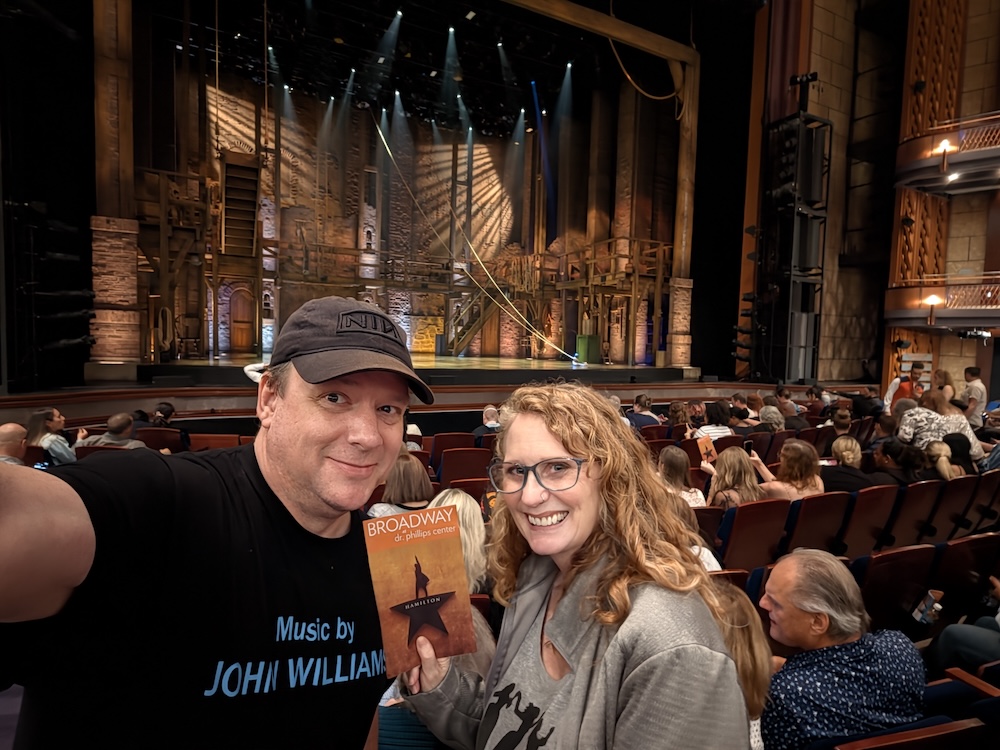
posted by Jeff | Friday, October 9, 2026, 4:00 PM | comments: 0It felt like the longest wait ever, but our Broadway season finally started this year with Hamilton. Our last show was Six on June 3. Typically we see the first show in September, so maybe that's part of the reason it felt so long.
This is a show that I've now seen eight times, mind you, but it was just staggering that after spending so much time in my head with all of the things that trouble me, I can't remember a recent time that I felt as present and in the moment. OK, seeing Come From Away with our local company down the street was close.
Live theater, which unfortunately can be pretty expensive, is one of, if not the best kind of entertainment. There is something about people pouring it out on stage, in front of you, in real time. It will never be done exactly the same way again. You're there for a moment that will live only in memory. There's something wonderful about that. This year we have three great returning shows, five we haven't seen (of various levels of acclaim), and, ugh Sound of Music.
We've changed up our routine, where we go to a local pizza joint and bar down the street before the show. Drinks are stupid expensive at the theater now, so we drop in the donor room for snacks and spend nothing there. The tickets are obviously paid for already. I like the vibe at the pizza joint, and the bartenders are pretty cool.
Still, I love being in that building. We've been going now for 12 years, and it's one of my favorite things about living here. It's just strange that Diana doesn't work there anymore.
When you think you can solve all the things
posted by Jeff | Tuesday, October 6, 2026, 8:22 PM | comments: 0I'm definitely at a point in my career where I don't generally see new things in my work. Sure, the tools change, but the people and process problems really don't that much. Even the technical problems, they haven't changed that much, not even with AI.
As I understand it, it's not unusual for people with autism to observe a situation and instinctively say, "You're doing it wrong." My kid is like that, too. The difference between us is that he will blurt out obscenities at poor drivers, whereas I'll take one of those work situations and say, "How can I help make this better?" The underlying sentiment is not that different.
Oddly enough, when I've been in a position to have more influence and responsibility, I didn't have the experience that I do now. I also realized at one point that I like being closer to the makers, getting into technical design and having real accountability in shipping stuff. Being a line manager is far more satisfying than trying to be a CTO. Still, I have this strong urge to fix things that I know could be better. But if I can get beyond the instinct to correct that which is wrong (in my perception at least), I still have the moral dilemma of whether or not I'm being professionally negligent.
At my last job, for example, there was an opportunity to greatly simplify system architecture by consolidating API's instead of having a ton of one-off things to maintain. One gateway to rule them all, without the complexity of dependencies and coordinated releases. This was not my problem to own, but it felt like an obvious thing to make life easier for many folks, and shut down a lot of redundant compute. However, the more involved that I got in trying to make it happen, the more distracted I got from my core responsibilities. Getting nowhere in building consensus and priority, this time I eventually walked away from it.
I think there are two things to think about. The first is that we rarely understand the depth of experience for any given individual. Sometimes we'll remember something on a person's resume from their interview, but most of the time, we just don't know. The second thing is that it's too easy to get sucked into the idea that we can solve all of the problems. It's not that we shouldn't leverage our experience, but changing lanes means you might not be as good at your primary thing.
The bottom line is that I need to learn to let go of some of the things that aren't mine. The idea that I can fix all the things may be hubris.
Remember waiting for a table at restaurants?
posted by Jeff | Monday, October 5, 2026, 8:37 PM | comments: 0Diana and I went to our local Outback restaurant the other day, while Simon was at the parks. I don't remember how we ended up with a gift card, but ordinarily this isn't a place we would go. In fact, we don't really go to national casual chains very often in the general sense. There are just better options with better food (not to mention a ton of great restaurants on the theme park properties). Outback was fine. You can't really screw up chicken and a baked potato, as long as they're seasoned right.
There was a time though, in Cleveland, where I would frequently visit the big chains. This was before the foodie scene started to expand there, and before the chains seemed to mostly just microwave all of their crappy food. Stephanie and I periodically went to Outback as part of a cycle that included Best Buy. That was in my buy-lots-of-crap phase. And I know we went there on credit sometimes, too.
The crazy thing that I remember was putting your name in and hanging out, sometimes for a half-hour or more, to get a table. That's nuts. If we went anywhere today, if there was anything more than a 10-minute wait, we'd turn around and go somewhere else. We were so tolerant then of waiting. This would happen at TGI Friday's too (again, when the food was OK). I vividly remember going outside if it wasn't too cold, because I couldn't deal with waiting in a crowded, noisy area inside.
The other variable is the invention of fast casual, where it's not exactly fast food, but it's not a sit-down restaurant either. Chipotle is likely the most brilliant example of this, where they have real and fresh food, but there others. A lot of them have come and gone, but Pei Wei is still a thing, and locally we have a sushi/fusion place called Bento. These are not the crappy fast food stuffs like McDonald's or Wendy's. It's measurably better stuff, and oddly enough not that much more expensive than a McMeal. As a percentage, those places get more money from me than regular sit-down joints, and fast food is off the table completely.
I never really noticed the change, it happened so gradually.
The decline of an amusement park institution
posted by Jeff | Monday, October 5, 2026, 4:22 PM | comments: 0I'm sure I wrote about it back in the day, but the merger of Six Flags and Cedar Fair was a terrible idea. CF was making some missteps, but generally the company was functional and making money. Six Flags was cratering with an already damaged brand and management that had no idea what it was doing. All of the people responsible for that train wreck are gone, but the new leadership is probably making things worse. I wrote some thoughts on LinkedIn that have had an awful lot of views given my limited network.
If you go back to the start of my roller coaster and theme park fascination, say, 1998-ish, there was a consistent, decades-long dominance for Cedar Point, the "home park," if you will. There were others, not part of Cedar Fair at the time, like Kings Island, Kennywood, Holiday World and such. In 2006, Cedar Fair bought the Paramount Parks, and the transitions was pretty rough. The CEO, Dick Kinzel, after decades leading a smaller company, engaged in hubris believing he could just apply the same practices to every park, which did not work out. He did the same with cross-town Geauga Lake. He kind of overstayed his time, instead of leaving on top.
But then Matt Ouimet lands the CEO job next, and brings a ton of Disney and hotel experience, unlocking a lot of the potential of Cedar Point specifically, but also finding the different potential at all of the parks. This is all through a stretch of time where I made a lot of friends working in various roles there, including the GM for awhile. It made me realize that regardless of the rides, it was the people that really made it special.
Since the merger, and a revolving door of leadership, the company has let go of so many people, that it's unclear who is still there to run the parks. For the first time in 28 years, I don't really know anyone at Cedar Point. That's pretty weird. Mind you, I don't live close, so the park doesn't nearly have the importance it once did. But it feels like the end of an era.
Amusement parks and theme parks are not a slam-dunk as far as success goes, but there are proven fundamentals that have worked for decades, and still work. The private park companies are all doing pretty well, and Disney is killing it too. Comcast says their Universal parks missed targets, but they're not hurting, as best I can tell. Above all, these are hospitality businesses, and those are built on people. Letting go of all the people will not make it better.
Back to scope basics in software development
posted by Jeff | Tuesday, September 29, 2026, 2:00 PM | comments: 0It took a lot of trial and error to arrive at a place where I was confident that I could get fast, high quality results from dev teams. I got a lot wrong, and ended up on side quests to have more influence and responsibility. But getting back to the makers, the teams of software pros, revealed some basic truths. The adoption of AI seems to have cast those truths aside, resulting in a lot of expense but not better outcomes. That's a bummer because AI can absolutely improve delivery.
First truth: We don't know what we don't know. Obvious, right? We stopped doing waterfall development decades ago because we never delivered the "right" thing. A lot of time up front is spent getting the "what" and "why" set in excruciating detail. Much of that generated detail is wrong or unnecessary. Some folks today are obsessed with throwing extreme detail over the wall to the bots, none of which has been vetted as necessary to real users.
Second truth: Iteration yields faster and higher quality delivery. This is where the self-appointed AI influencers get it right. But "loop" engineering wasn't invented yesterday. A tight feedback cycle gets you to delivery faster. It always has. The problem is all of the aforementioned detail. When you reduce scope, there's less to get wrong in terms of functionality, quality and defects.
Third truth: Code review improves outcomes. By this I mean, human review. If an LLM is trained on anti-patterns and garbage (because it doesn't know the difference), you can't rely on it to get it right. But there's a bigger thing folks are overlooking. If a human doesn't review the code, no human understands how it might break, or what to do if it does break. You can't expect the machine to do better when it didn't in the first place. The non-deterministic nature of agentic coding is the reason you need people to understand how things work, so they can predict failure modes at a granular level.
What AI has fundamentally changed is the ability to turn requirements and ideas into working software, faster. That in turn makes it faster to interpret and respond to user feedback. Even better, it means the cost of experimentation is lower than ever. We can try stuff with less risk and expense. This all relies on keeping scope smaller, not large and detailed, just so you can say you threw it over the wall for the bots to do overnight. That feat of engineering has never been the goal. The goal is to make delightful software that makes you money. This exciting new tool doesn't mean you throw away these known effective practices.
The love bugs' signal
posted by Jeff | Monday, September 28, 2026, 6:35 PM | comments: 0If you're not from around here, we get these little critters called love bugs (Plecia nearctica). Apparently they only live for a few days, but boy do they muck up the front of your car. They're not as bad as midges or mayflies around Lake Erie. They call them love bugs because you generally see them in pairs, connected at the ass. When you see them, they signal roughly the start of swamp-ass season, and the end. They show up in June, and then again in September.
So it was with great relief that they've been out lately, because it means we've finally crossed that bridge back to the weather people move here for. Last week we had a day that didn't even reach 80, and it was glorious.
Weather is always the go-to for smalltalk, but there isn't as much to talk about when you don't have serious seasonal changes. We just have our three to four months of "gross" and then it's amazing the rest of the time.
One glorious year of pinball ownership
posted by Jeff | Friday, September 25, 2026, 5:20 PM | comments: 0Way back in 2000, I bought a Data East Jurassic Park pinball machine, a fun reward for selling popworld.com for $100k. It was $1,800 at the time, which in retrospect was a great deal. I bought a laptop around that time that was $2,500, which is an absurd $5k now (not sure what I was thinking). But in 2009, I sold it, because it didn't seem like a great idea to move to Seattle with it. That was kinda dumb, considering we didn't have to pay for the move. When I thought back about the joy that brought me, and the hit that it was at parties, I always thought I'd get another one.
But life kept happening, and I kinda forgot. A few years ago, Stern put out a newer JP machine, and I thought about it getting one. New machines cost as much as $10k these days ("NIB," new-in-box, as the nerds say). I fancied a new one because the tech had evolved so much, and the idea of having something that I knew all of the maintenance history of was neat. The old JP machine was pretty solid, and I think I replaced only one rubber part. Everything else was minor, like the shaker motor getting loose from its mount, regular cleaning and dirty sensors.
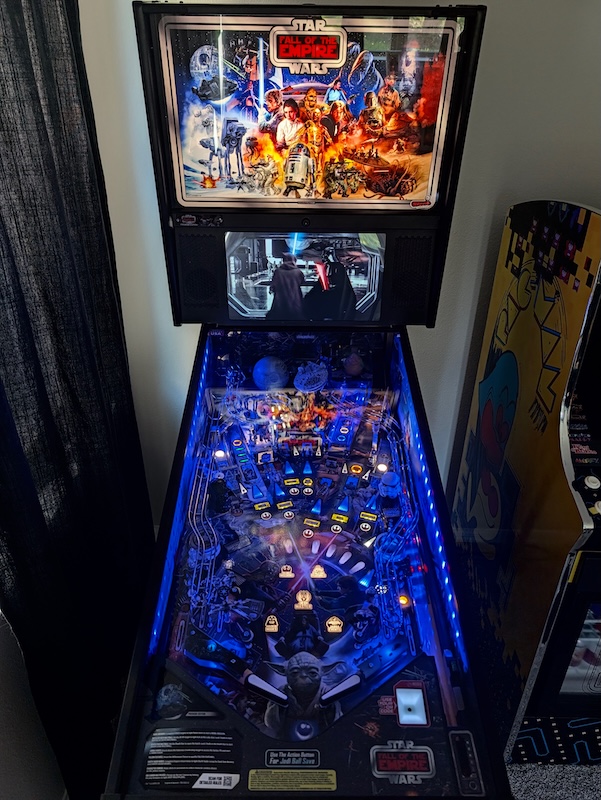
About a year ago, Stern released Star Wars: Fall of The Empire, and I was pretty excited about it. Neat IP, obviously, but also the game was very straight forward, with just a couple of cool toys in it. I barely had to think about it, and Diana had no objections, so I bought it, "NIB." I still vividly remember unpacking it, the smell of wood and paint when I opened it up. Can't believe it's been a year. As of right now, it has 3,620 plays. Almost 2,500 of those are me. As was the case with the old JP, this machine has brought me a lot of joy.
In terms of maintenance, right out of the box there was a bad light socket that was shorting, and that caused the bottom half of the playfield to stop working (including the flippers) until I disconnected the string of white lights (what they call "general illumination"). I probably could have replaced it myself if they sent the part, but out of the box, I insisted that the distributor fix it, and they did. There was also a design problem with the bracket around the entrance to the Death Star. It was too narrow, so the ball would bang around and not go in. Stern had a replacement bracket, and they sent it, I installed it. It was night and day better. I got Death Star multi-ball on the first game after the fix.
I also added two parts: A shaker motor and the expression lights along the sides. These both come in the LE models, but that version costs $4k more. Together, the motor and lights cost under $400. Beyond that, the difference from premium to LE is mostly the outside graphics and paint. The only case I've seen where this really matters is the new Fallout machine, which sold out in the LE variant in the first day anyway.
Beyond that, I've replaced all of the rubber bits. As best I can tell, these were the source of much of the dirt building up and making ball trails. I replaced them all with silicon parts, which are more durable. When you rub your fingers on them, it doesn't turn them black the way the old stuff did. They can break too, as Diana found out mid-game once. The band around the right sling takes a lot of abuse at the bottom corner, when you have the flipper up and trap a ball there. Now I know what to have on-hand. The post pads wear the most, slings second. I have an even better alternative for the slings (more expensive, but still like 90 cents each), but I'll let what I've got wear out fist. Oh, I replaced the balls, too. They were visibly pretty scratched up and dull, which isn't great to have flying around the playfield.
Mechanically, everything should last a good long time, though they suggest rebuilding the flippers every 5k plays. Slop builds up in the linkages over time. That should be straight forward. I really enjoy the maintenance, because it's easy and predictable, and satisfying. Like taking care of a car, but without all of the oil and grime.
Now, the question is whether or not I can justify getting another...