Archive: June, 2026
Users care about outcomes, not AI
posted by Jeff | Sunday, June 28, 2026, 1:18 PM | comments: 0The usual hot takes revolve around the use of agentic AI for coding, but let's talk about the other business uses for AI. There are various ways to spin up your own domain-specific model. Maybe you want to predict what users need based on past behavior, connect people looking for dates, or find patterns in loads of data. There are a lot of ideas out there that just became a lot easier to implement.
I read a quarterly earnings statement recently that mentioned AI 70 times. Their adjacent shareholder letter mentioned it 60 times. If you're an investor, maybe you care, for another quarter, but the fact that a company is using AI does not make them special. If everyone uses AI, no one is special for that. (This company's stock price did not change on this release, and in fact it went down.)
But the biggest mistake is talking about AI to your end users. I can tell you with certainty that they don't care about AI. They care about the problems your software will solve for them. AI is an implementation detail, and is about as important to them as the language you use to build your stuff, which is to say, not at all.
Let me use the LinkedIn trope of a single-sentence paragraph: AI is an implementation detail.
Worse yet, if you're hollering about AI instead of the outcomes you should be selling, you might lose a significant share of customers. Stanford's AI Index Report shows that more than half of those surveyed say that products that use AI make them nervous. Even though it's not an apples comparison, you also see growing backlash in creative communities, as well as in certain medical and psychology fields. And don't even get me started about the anti-datacenter movement. Are you sure you want to associate your product with that?
I'm not saying that AI is good or bad, because that's a complicated and nuanced discussion. I think it's an essential tool for an endless number of business cases. But saying that you use AI in your product is like saying that your car has wheels. It doesn't really mean anything. When containerization caught on, you didn't see people shouting, "Our product now runs in containers!" Nobody cares.
What you can describe is the outcomes you can provide. Your online store can point users at the products they actually need. You can make that romantic match. You can help people see patterns in their data. That's where the value lies, not in the fact that you used AI.
My head, headed into Jeff Putz week
posted by Jeff | Friday, June 26, 2026, 8:35 PM | comments: 0It's that time of year again, where I do some combination of celebrating my life and ponder my inevitable demise. This year feels different, and I'm gonna try and unpack why that is.
The year started poorly right away, when 350 of my colleagues and I got laid-off from Angi. Really put a damper on celebrating my four years with the company. I took it in stride at first, but somewhere deeper it was grinding me. March seemed to show promise, when Diana scored a new gig with Blue Man Group, literally on our way to our next cruise out of Ft. Lauderdale. That trip started out well, but Simon ended up being a handful, and I had my first real meltdown in quite a while, and not the last of the year. Diana had her appendicitis right after that, followed by weeks of complications that delayed any kind of normalcy for her. I continuously had one in-progress potential job lead most of that time, but got nowhere on cold applications. (I've got a whole post-mortem for that in the works.) Getting to the end of the school year was like torture. Most recently I had this CT that isn't alarming, exactly, but I can't say I'm in a "zero risk" category.
It wasn't entirely bad. I built TogetherLoop, which is only used regularly by a few people, but it satisfies my need to publish without gratuitously wide over-sharing. In fact, I feel like I became exceptionally good at slinging the AI robots to make stuff, and that makes me happy. I had a solid Code Camp talk. Our more recent cruise was awesome, upgraded and legitimately relaxing, if a bit too short. I've seen Diana's new show a bunch of times, and it brings me joy every single time. It doesn't get old. Oh, and we've had a more regular rhythm of "puzzles and LEGO" time.
But while there is good and bad, I find myself incapable of really feeling joy on any consistent basis. Some of that has been the job hunt, which to be clear, is partly about me not chasing really crappy "opportunities." But I've struggled to figure out where work fits in my life. Part of it was just that I really enjoyed working with my team, and it sucks not working with them. If that weren't enough, I see a future that is financially somewhat secure, or would be if I didn't have to wait seven years to get at most of it. It's very real that I'm not going to wait until 65 to retire, er, offboard to fun work. Add in the recent health realities (I can't really classify them as "problems"), and everything just feels weird. I'm already dreading what school looks like in the fall. I almost completely ignore the news and our political shitshow. I don't have anything left for that.
I suppose this is what they mean by midlife crisis, though mine is coming a little later than typical. I feel like I'm in a state of transition, change, limbo or something that is unsteady and uncertain, despite having a pretty clear vision of how the next five years play out. It might be the first time I've ever been able to answer the question, "Where do you see yourself in five years?"
The next week, starting Sunday, should be about fun. I start the new job the week after, so the timing is actually excellent. With that start, I have to make some lifestyle adjustments. No more soda at lunch, less snacking, more movement, and I probably should abandon weekend drinks until at least my next blood draw. Even if my triglycerides are not materially affecting my health, losing a little weight would certainly result in overall better health. I did it when we moved here, and I'm sure I can do it again.
I've got somewhere between 30 and 50 years to do my thing. I can't sit around moping in that time.
I de-iced the fridge again
posted by Jeff | Friday, June 26, 2026, 6:55 PM | comments: 0This is the classic kind of stupid shit to blog about that predates duck-face selfies, and I'm here for it.
Almost three months ago, I had to tear into my fridge and melt the iced up coil. I didn't get all of it, because there was this piece of foam over the coil that I couldn't remove. I believe the ice was stuck to it. Anyway, ice started to form again, so I pulled out all of the crap and went at it again. This time, I got it all.
There are a few reasons this happens. One is a bad heater coil. Related, a bad temperature sensor that turns off the coil when it's warm enough. If the fan that pulls air over the coils doesn't work, that's another thing. Fortunately, the fridge seems willing to tell you about a bad sensor, and you can also manually run the fan from the diagnostics. It's not the fan or the sensor, so maybe it's the heater. I don't know because I couldn't get to any obvious place to test for current flowing through it. The other thing it could be is a bad seal on the door, which also doesn't seem obvious.
It's certainly possible for it to just accumulate ice over time for no other reason than we the air is humid or the door is open too much. The heater can only go so warm for so long before it's heating the food, so there are limits to the system. Hopefully that's it, and me not getting it all the first time was the issue.
Homeownership, am I right?
CT revisited
posted by Jeff | Thursday, June 25, 2026, 9:42 PM | comments: 0It turns out there's a far more detailed analysis of my CT from another doctor. The way that the first read I thought that was the secondary. This one isn't "bad" per se, but it isn't what I'd like.
The left anterior descending artery shows some blockage, described as mild, non-obstructing. When I asked the AI for more detail, it said that these are the sort of results that prompt preventative measures, but not any immediate or urgent mitigation. It's also possible that the plaque build up occurred prior to my starting of statins 5.5 years ago. So the bottom line is that it's hard to say if triglycerides are linked, but the right thing to do is to try and get them down. That involves pulling the most obvious lever, which means getting off my ass. Ideally I need to reduce my carb intake, which seems like not living, in some ways. I suppose if you're active enough, that matters less.
This is actually more along the lines of what I expected, but it still sucks to hear it, even if the point was to know and do something with that information. These results actually put me in the high-average cohort of people my age, if that matters. I can only imagine where I'd be if I hadn't started the statins.
I had a CT scan of my heart
posted by Jeff | Wednesday, June 24, 2026, 8:43 PM | comments: 0I mentioned awhile back that I was rebooting my healthcare with a new primary care doctor. It was only about a month ago, but I feel like we've really moved along quickly, and I've been able to communicate with her via the patient portal. The goal is to figure out my high triglycerides, which is odd because normally those come down with LDL on statins, but mine have not. Throwing pills at it hasn't helped. So my new doc is first trying to assess what my overall condition looks like so we can decide how aggressive to be with it. My pancreas and liver are functioning just fine, so the next thing was to see how my heart was doing. Step one was checking my lipoprotein (A), a test that insanely is not covered by insurance. That test came back perfect.
She also wanted to do a CT of my heart. This also isn't well covered by insurance, but with a history of heart disease in my family, it would give me a look to see if my arteries were headed toward a "cardiac event." I'm sure you've heard that there's one in particular, the "widow maker," that if it isn't caught, your survival odds aren't great. Having a decent picture of most of the rest of my health, but not this thing, made me feel like the radiation was worth it.
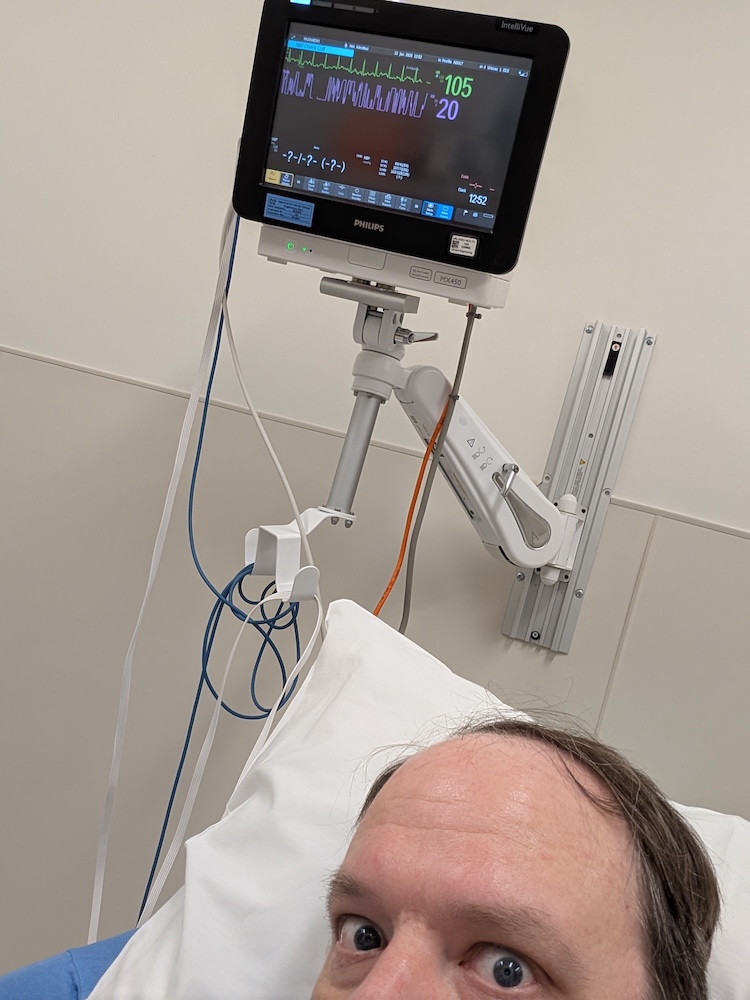
While it's relatively non-invasive, they do need to slow down you heart below 70 bpm, using beta blockers. These block the nerve receptors that react to adrenaline. Honestly, that freaks me out, as my sleeping resting rate is in the mid-60's. A CT zaps you with X-rays from all angles, using a rotating device, but to make that work, and build a 3D model, requires that your heart isn't moving around a bunch, which it does because it's your heart. So after two hours of oral blockers, then two injections of smaller doses, it got down to where they needed it and they took some pictures. So yay for getting three years worth of background radiation in a few seconds! To see better, they pump you full of an iodine solution, which when it hits your bloodstream, feels warm all over, and like you squirted hot diarrhea into your shorts. It's fucking weird. They also give you a hit of nitroglycerine, which opens up your blood vessels so you can see them better.
I ended up being there for like three hours, which was not ideal. But as was the case with our recent experience with Diana's appendectomy (same hospital), the folks there were excellent care givers, and I never felt weird about it.
The results hit today, and the radiologist described the CT as "unremarkable," which is to say nothing weird, and low risk for cardiac illness. That's kind of what I expected, given the Lp(a) test. But I was anxious about it all night, and you isn't it funny that when you think about it, you're sure something doesn't feel right. That was one of two huge exhales today. Also, the TG problem might be related to my vitamin D deficiency.
Leadership is listening
posted by Jeff | Wednesday, June 17, 2026, 7:44 PM | comments: 0Think about the best leaders you've worked with. What separates them from the crappy leaders? At the top of your list is probably that they were willing to listen to you. I'm not talking about giving lip service about listening, but actually hearing what you have to say. They may not agree with you, but they're willing to explain why when they don't.
We generally understand that we have to listen to customers, but for some reason, certain leaders are unwilling to listen to the people who make the proverbial sausage. No person, especially when charged with running a company, can know everything about what happens down the line, nor should they have to. But while they must delegate, they must also hear from the delegates. That has to chain down to the line worker, whether it's a software engineer or someone mounting bumpers on cars.
There are two big misfires that I often see. The first is that success breeds a sense that they need not listen. This is hubris and arrogance, but it doesn't feel like it in the moment when things are good. But the desire for continuous improvement, and accepting that things can and will change quickly, is reason to keep listening. What you do and how you do it can't remain static.
The other thing is a classic middle management mistake. They make decisions or hand down processes or protocols with zero input from the people that need to implement them. If you ask them what the success criteria of these changes are, let alone how to measure them, they likely don't have an answer. I know about this one all too well, because earlier in my career, I was guilty of doing this. I invoked changes that worked in a contextually different and irrelevant scenario, and people did not react well.
These are cultural issues that often permeate throughout an organization. Some early leaders that I worked for didn't listen to anyone, they just made decisions, and when things were good, I figured that this is what leaders did. It had negative morale implications, but we were still getting paid, so who was I to judge? It's when things go south, that you start to see how important it is to get all of the information, from customers and from the people who make your things.
I have (reluctantly) joined the smart watch universe
posted by Jeff | Tuesday, June 16, 2026, 4:30 PM | comments: 0When the Apple Watch came out eleven years ago, I though, what is the point of that? Like I need another screen nagging me about stuff. A few years later, I worked with a guy who you couldn't have a conversation with because he was constantly looking at his watch. Apple seemed to struggle with figuring out the point of the watch, as did Samsung, and later Google. But I suspect that the Garmin users of the world got it... it's great for gathering health data.
I bought into the Fitbit idea right away in 2013, and I've had three of them total, lasting a few years each. The first one was intended to just be clipped on to some part of your body, while my next two came with a band, but you could still clip it. I've tracked most every step that I've made since. (Spoiler alert: I've been pretty lazy the last few years.) But the battery started to crap out on this one too, and I started looking at my options. Diana and Simon both have Pixel Watches, since they're pretty seamless to use with Android phones, and I'm impressed with the sheer volume of data that it can record. Rebranding the Fitbit app as Google Health, believe it or not, actually makes sense, and I kinda like it better.
So I decided to give it a whirl. I used to wear a watch until about 1995, when I started carrying a pager (ugh), and it had the time on it. Obviously when phones came a few years later, the same thing applied. I tried to wear the Fitbit as a watch on a few cruises, and didn't care for it, but the screen was small and it just felt weird. The watch feels a little strange, but I think I'll get used to it.
That said, my earlier commentary on "MOAR SCREENS!!!1!" still stands. My phone only notifies me of text messages and personal email (never work email). That's what I allow to pass to the watch. Otherwise, it's for counting steps, measuring sleep and reminding me to get off my ass, if in fact it does that. Oh, and I guess it tells time, too. I ain't getting younger, so I suppose being reminded that my time is limited is probably OK.
I think I need a better band for it, but the rubber one will be appropriate for vacations where water is likely. Also, I like that it's properly round. Garmin and Samsung agree, but for some reason Apple is sticking to the ugly block.
No sense of weekends
posted by Jeff | Sunday, June 14, 2026, 4:31 PM | comments: 0Diana, working in the arts, has weird schedules. She's been back to full-time for a few years now, and it's still weird. She previously had Monday's off, typically the dark day for the arts center, and now Blue Man Group is the same... until they get to their summer schedule. They have ten shows a week in July. During the holidays, it's as high as 18 shows!
Generally speaking though, and especially with me not working, our "weekend" tends to start on a Sunday night, since she doesn't work late, and then Monday is clear. There was a little re-org this week, so she's been doing some overtime, but tonight I'm waiting for our puzzle-lego night. This is where we hang out at the kitchen table, put on tunes, make a few drinks, while she does puzzles and I find some LEGO to build. I'm sure I've written about this. Even though I want to reject routine, because it makes time move faster, this is something that I look forward to.
I've got several interviews this week, so I'm hoping to get some normalcy soon. I'm sure I'll write about it eventually, but that process is so broken.
Life in touring road cases
posted by Jeff | Sunday, June 14, 2026, 3:10 PM | comments: 0Every year, there's a new video that documents the production of the Eurovision Song Contest. The scope and size of the lighting rig is spectacular, and it's not the usual grid of flash-and-trash stuff that you see on the average tour. It's really inspiring, if a little unrealistic since they clearly have a budget that is beyond typical. Also crazy what you can control with Grand MA3. There's no difference between what they're using and what I have, aside from the number of things that you can control.
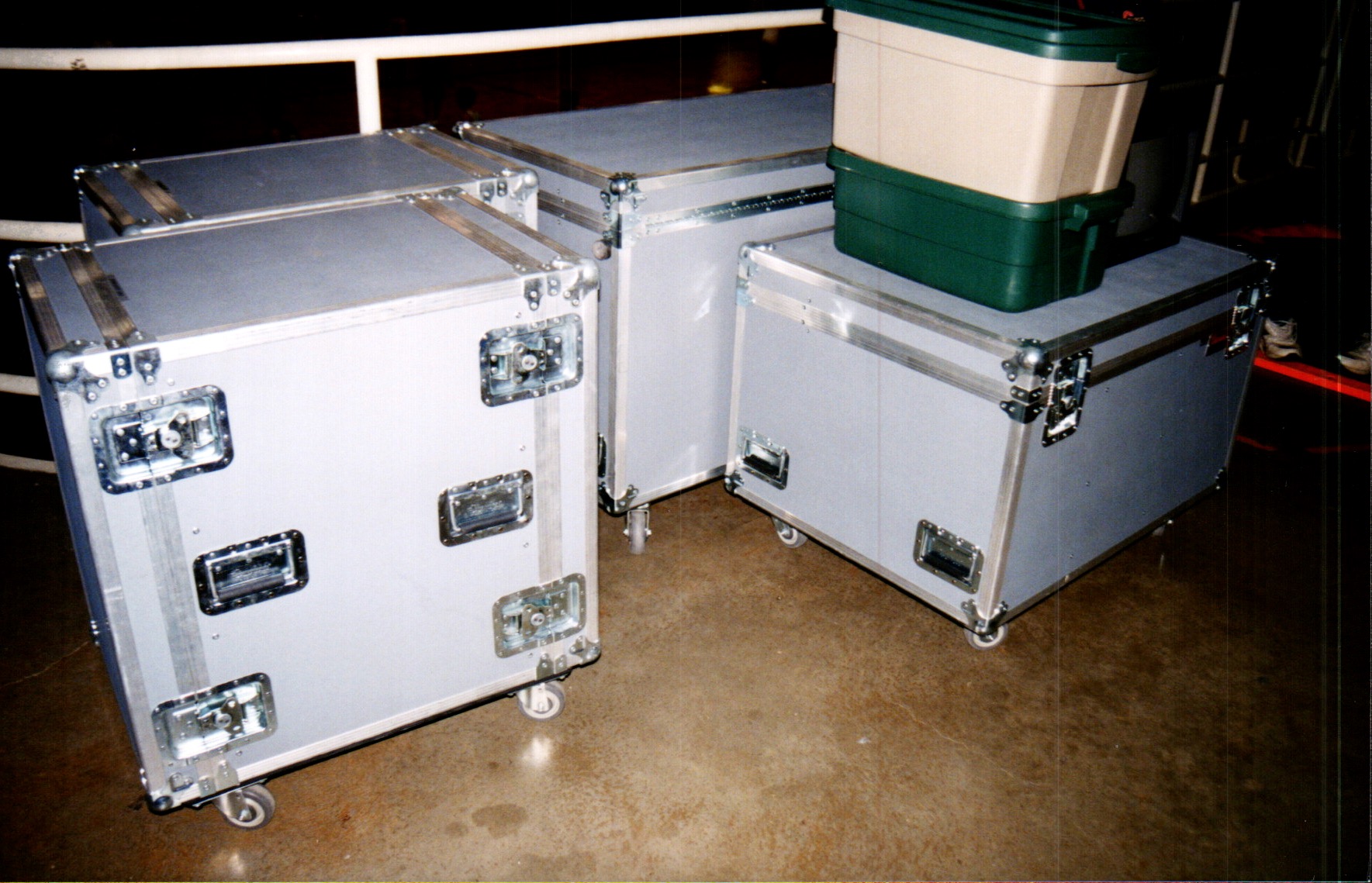
Anyway, the video always has a ton of road cases, which are generally made custom, but they all use the same parts. Aluminum rails, reinforced corners with the "bubble" on them, the twist clasps and such. They haven't really changed in decades, even though a lot of the gear that you put inside of them has. I have one for my console. It has wheels and a handle like a suitcase, and the console just sits in the bottom and you take the upper part off.
The first cases I ever touched were stacked with TV gear in my city's cable TV office, where I worked. After college, when I assumed a similar job in the neighboring city, I did something similar because I didn't have permanent studio space, so making as much of it portable as possible was necessary. I had four cases... two racks, one for cameras and a big one for tripods and cabling. They were obnoxiously large, but only when loading them in and out of the van.
There's something incredibly satisfying about moving around a bunch of stuff, setting it all up, doing the show, then tearing it all down and doing it again somewhere else. In that cable job, we did it about 40 times a year. The routine stuff was public meetings, but then we also did things like basketball games, orchestra concerts, high school graduation, and once we even did a live call-in show, turning my office and neighboring office into a makeshift studio. We used a lot of gaffer's tape.
The most satisfying part was at the end of the night, when you had it all packed up again and you had a tape in your hand. The room looks like you were never there. I can only imagine what that's like for a touring show.
Nothing to look forward to
posted by Jeff | Thursday, June 11, 2026, 3:53 PM | comments: 0I was reflective about times in my life where it felt beyond great to be in the moment, and how important it is to be present. I still believe that, nothing has changed, but I feel borderline panicked about not having any big "things" on the calendar. No trips, special days, shows or anything else that I really enjoy. That's not a good feeling. (I do have some interviews that are being scheduled, which is good, but not the same thing.)
A large portion of this feeling is related to not working. I became very used to not having to prioritize fun things, which has been great for the purpose of trying new things, hobbies and such. It's unsurprising that my mind isn't exactly one stimulated by "playing in dirt," as they say. Another thing is the deeply ingrained feeling of responsibility I have to being a provider for my little family. I understand why I'm this way (because lots of therapy), and it's hard to pause or reduce that feeling. I feel like I'm not really doing that. Worse, I have to reconcile that with a growing feeling of following my bliss, for me, for whatever that means. That's really hard to act on when I can't even define it.
The usual line of questioning from my therapist starts with, "If you could be doing anything, right now, what would it be?" My brain immediately goes into thought spirals and I can't answer. I mean, the answer is probably, "Run a light show and make cocktails for all of my favorite people at a fundraiser for the arts and GKTW that's happening on a cruise around Norway," but that's not really a thing. (It's hilarious and frightening that my head could generate a sentence like that with little effort.) Ultimately, the negative feelings stem from not seeing a path to some reasonable variation of that.
What's odd about that is that, professionally, that sort of problem solving has been my job for a very long time. Whether writing software myself or leading a team to deliver something, by trade I reduce ambiguity and scope, break down problems into smaller chunks, apply known patterns or new ones, focus the execution and make things happen. I was pretty damn good at that in the last four years in particular. Why is it so hard to do that in my personal life? I guess it's like they say, a therapist can't counsel themselves.
The weeks leading up to that last cruise felt good even when I was idling, which doesn't feel good now because I wasn't really living in the moment. While I was on the ship, I developed the most vivid memories. I'm sure it isn't realistic to apply that expectation to every hour of every day, but it'd be great to get closer to that. To me, that's what living should look like, even when it involves the most simple things.
Lean into what you already know to make AI coding work
posted by Jeff | Wednesday, June 10, 2026, 8:28 PM | comments: 0The Internets are ripe with videos and blog posts telling you that you're doing it all wrong. This isn't really different from anything we've ever seen in technology. People understandably want to sell themselves and appear valuable. But in the last two years or so, I've found that agentic coding involves using a lot of what you might have already been doing.
The overwhelming sentiment is to create more stuff so that Claude gets more right. And then check it when it's done anyway to make sure. For all of the anthropomorphizing that people do with AI, maybe they don't do it enough. I've had pretty good results, and speed, just doing what I already expected to do with humans.
This is the part where I remind people that the longest part of product development is deciding what to do, not how to do it. As engineers will tell you, a lot of our time is spent reducing ambiguity, and getting into fast feedback cycles so we build the right thing. And if you manage engineers, you know that telling them to do something and come back when it's done is disastrous. Yet, this seems to be what people want AI to do. Great, you spun up a dozen agents in parallel, cool story, but was that the goal or requirement? Of course not.
To seed a project, I direct the machine to setup a certain structure, generate some YAML for builds and whatever, and then write how I think the project should be built architecturally in the CLAUDE.md file. I break it up between the natural boundaries of system components. So that means there's usually some kind of API project that's just plumbing to business logic and service classes. I have bits that bridge those to databases, caches, message buses and such. Then I figure out what is the smallest possible thing that I can build, and have it do that, broken up the same way I would for humans, basically creating tasks in each of the above areas.
Feature work goes the same way, splitting it up into the component bits, doing each one, reviewing each batch of changes. For example, direct messaging took about two hours when I added it to TogetherLoop. It's a great example of using the tool to fill in my knowledge gaps. The trick isn't schema or business logic or web sockets, all of which are easy enough to describe and get solid output. But there are a dozen rules around scrolling that I didn't think about, and wouldn't have known how to code without research. It took awhile to get it right, and produce serviceable code, but it was faster than me trying to figure it out. (Full disclosure: I built a similar feature many years ago in POP Forums, manually, and it took a few nights of work.)
What I'm getting at is that this is no different than the way I would treat pairing with others or planning out how to execute something with a team. Yes, Claude does some really stupid things, and is overconfident in its assessments, but you see it, you redirect and you move on. Trying to get it right the first time seems like a colossal waste of time. Fast iteration and doing the next right thing gets you there fast without trying to box it in with pages of text.
I need to sell some stuff
posted by Jeff | Sunday, June 7, 2026, 1:27 PM | comments: 0No, this is not a reaction to non-employment. It's not that I need the money, it's that I'm not so sure that I need the stuff. I'm kind of foreshadowing some future downsizing, sort of. See footnote.
I've acquired a lot of Lego sets, and realistically, there are a several that I don't see myself building again. Some are more interesting than others. I have a handheld PC for gaming that I thought I would use all of the time, but I just assume use my desktop or Xbox. That can probably be sold. I could probably unload some of my video gear, too, though that would be associated with all sorts of negative feelings because I didn't complete the thing that I bought it for. The DVD collection, which I already reduced by half at the last move, could mostly go. There are boxes of media in the garage that I'll never look at again, or in some cases can't (no telling what's on all of that 1/4" audio tape), but a lot of that just becomes garbage.
I'm not sure what it is, but I feel like I want to be "lighter" and less encumbered. Can't even explain why, since I'm not going anywhere, as far as I know. I feel like I'm channeling "Ryan" in Up In The Air, with his backpack metaphor.
Footnote: Regarding downsizing, there's a part of me that wonders what that would actually achieve, and it raises the issue about the affordability of housing. When I've modeled a move that allowed us to use the equity in our house to buy something outright, it's just not that simple. Property tax and insurance still happen, and even here in our current McMansion, they account for almost half of our mortgage payment. Add the HOA dues and less than half of what we pay actually go toward owning the house. So when I create a budget in today's dollars for what it might cost during "offboardment," there's still a lot of housing expense even if we own the place.
Positive vibes, but this one thing
posted by Jeff | Friday, June 5, 2026, 9:27 PM | comments: 0As I sit here listening to "Control Freak" by Armin van Buuren (if you know, you know), I think about how positive I am about so many things. I feel like the world at large is headed toward a turning point. I see positive things happening among friends. My long-term financial prognosis is improving. My health is apparently solid (forthcoming cardiac CT not withstanding).
And yet, there's this thing hanging over my head. The thing is obviously finding another job. One that is amazing and exciting and shows potential the way my job at Angi did. Ugh, it still bums me out. How often do you get to work with the same people for four years-ish that you adore? To be fair, the first month post un-jobbed, I was content to do nothing but do stuff that fed the soul and just mess around. This was followed by a month of concern around Diana's appendectomy and the bizarre complications that came after. But by early March, I was focused on landing a new thing.
I've had four serious loops in that time, and they all ended in defeat for various reasons that either don't sit well or are a mystery. (There's a larger debrief for this to come later.) I'm in two loops now, but I can't easily assume the best, just because of the previous things. It's just so different from 2022, where I was fighting off parasitic recruiters and had multiple options and offers, because I'm experienced. I'm coming off of my most successful job in my entire career. I have numbers that show it. It shouldn't be so hard.
Meanwhile, I built a full-on social network that is fantastic, with all of the features you'd expect. It doesn't invent anything new, but it's ad and algorithm-free, and I love it. I'm not really the marketing type to figure out how to sell it, but it's solid. I look over at the tablet playing music (now it's Sofi Tukker's "Purple Hat"), and love the improvements I've made this year. Heck, I've made some solid improvements on various backend functions of CoasterBuzz, which I haven't touched in years. Agentic AI coding is fantastic. I'm not sure that I've ever been this excited about tech stuff.
But I need another job. One that lasts two or three years would get me to a solid spot that I could in fact "offboard" or whatever. It can be longer, for sure. If the people are awesome and I'm enjoying it, I wouldn't move on. It's not that I don't want to work, it's that I want to do stuff that is awesome. Angi as a company was "meh" in terms of its intent, but I worked with some of the best people I've ever worked with. I miss that.
Trying to disassociate identity with work is harder than I thought.
The AI bubble just got closer
posted by Jeff | Thursday, June 4, 2026, 10:12 AM | comments: 0If you (or your employer) can afford one of the more expensive Apple silicon computers, then you know that the machines can run LLM's well enough. You just need a lot of that unified RAM. More and more people are experimenting with this, and having various degrees of success. This is the foreshadowing that I've been talking about when it comes to an AI bubble. The music analogy is that you no longer need a recording studio if you have a laptop. The AI data centers are the recording studio.
Now Microsoft announced the Surface Laptop Ultra, and the desktop Dev Box. These use Nvidia RTX Spark silicon, an approximate analog of Apple's M-series. This means that the massive power found in the Macs of the last few years will compare to something similar in Windows. The ubiquity of local LLM running ability is coming.
The availability of this hardware, along with increasing end user costs for AI agents, will converge in a way that I think will legitimately harm the big AI companies. I don't know how it will shake out, but the only way it doesn't happen is if open source models can't compete with the "big AI" models. They're already "good enough," if you have the hardware to run them on. That hardware will get cheaper over time.
Agentic coding is certainly just one use of AI, but apparently it's the segment that actually makes money (if not profit) right now. Search and advertising also benefits from this, but Google and Meta own their own infrastructure. Support bots and the like often run on the cloud providers, not AI firms' hardware. While I admire the advancements of Anthropic, OpenAI and such, it's not clear what their long-term play is. Developing great models that eat insane amounts of compute isn't sustainable. And that's not even getting into the pushback from everyone about building data centers.
Don't get me wrong, I think being able to run a local model is a future that we as software people can get into. I've messed with it, and it kind of works with less robust models that will fit in my rig. I need a computer anyway, so if it can do this, why would I pay someone else? Exciting stuff. I don't think it'll be so great for my retirement accounts in the near-term.
Nineteen years after our first date
posted by Jeff | Tuesday, June 2, 2026, 8:42 PM | comments: 0Last weekend's cruise was a nice, if entirely too brief, escape from the usual things. The room upgrade was fantastic. When I booked it back in December, I figured that we had not done a proper "us" celebration in awhile, which is how I justified a concierge stay. The upgrade made it feel quite a bit more "luxury," as the suite had a dining table and the primary bathroom was enormous. It had a beautiful mosaic on the bathroom wall above the tub.
Concierge is like having your own little world, with a dedicated lounge, and a sun deck that is wholly underutilized. The Disney ships do a good job at distributing people in various ways, so it never quite seems crowded, but this gives you a level of exclusivity that's pretty extraordinary. The first night we sat in a hot tub by ourselves, and another day we hung out there with just a few other people. They have a bar in the lounge that's open from 5 to 10 everyday, so while we didn't drink a ton (too much food for me!), we didn't pay extra for very much either. Free popcorn, too, which is Simon's "big" expense.
Getting back to the celebration, May 31, 2007, was the day I met Diana, and 19 years later, it still seems like a big day for us. Our wedding anniversary is nice, but the day we met is a day that fundamentally changed our trajectory. It just seems unlikely that we would have met, especially in our 30's, dating online.
We talked for several hours that night, which was not a frequent occurrence in my dating experience, maybe because connection just didn't come easy to me. We talked about theater stuff, our career paths and such. By the end of the year, we moved in together, and married less than 22 months after we met.
I like to think that your outcomes are deliberate, but sometimes you just get lucky. I landed with someone that I'm never angry with, look forward to seeing everyday and I know she supports me in every way. As best I can tell, that's uncommon. I love you, dearest!